
Services
Process Documentation and Operational Enablement
When important work depends on memory, Fablehaus Werks turns the way your team actually works into clear, usable guidance that supports consistency, onboarding, and dependable handoffs.
Document the decisions people make, not just the clicks they take.
When the process lives with the people
The work is understood, but not easily transferred.
The process may run well while the experienced people are available. Risk appears when someone is away, a role changes, a new person starts, or the workflow itself needs to change.
The real process lives in memory
Experienced people remember the sequence, exceptions, contacts, and judgment calls that keep the work moving.
Instructions lag behind the work
Existing material is incomplete, hard to scan, or disconnected from the tools and decisions people use today.
Handoffs change the outcome
Different people complete the same work in different ways because ownership, required information, and completion are not clear.
Change creates another explanation cycle
Every update relies on meetings and repeated coaching because there is no dependable reference to support adoption.
What becomes easier to carry forward
The process becomes teachable, repeatable, and maintainable.
Useful documentation gives people enough context to act confidently while making ownership and change easier to manage.
- A usable operating reference
People can find the steps, decisions, ownership, and required information without reconstructing the process.
- More dependable handoffs
The next person receives the context, records, and responsibility needed to continue the work.
- Practical onboarding support
New and backup staff have material that supports learning without pretending a document replaces guidance.
- Clear ownership for change
The organization knows who maintains the material and how updates should be reviewed and communicated.
How we capture the real work
Turn working knowledge into guidance people will actually use.
We observe the real workflow, capture the choices and exceptions inside it, and select formats that match the way people need to use the information.
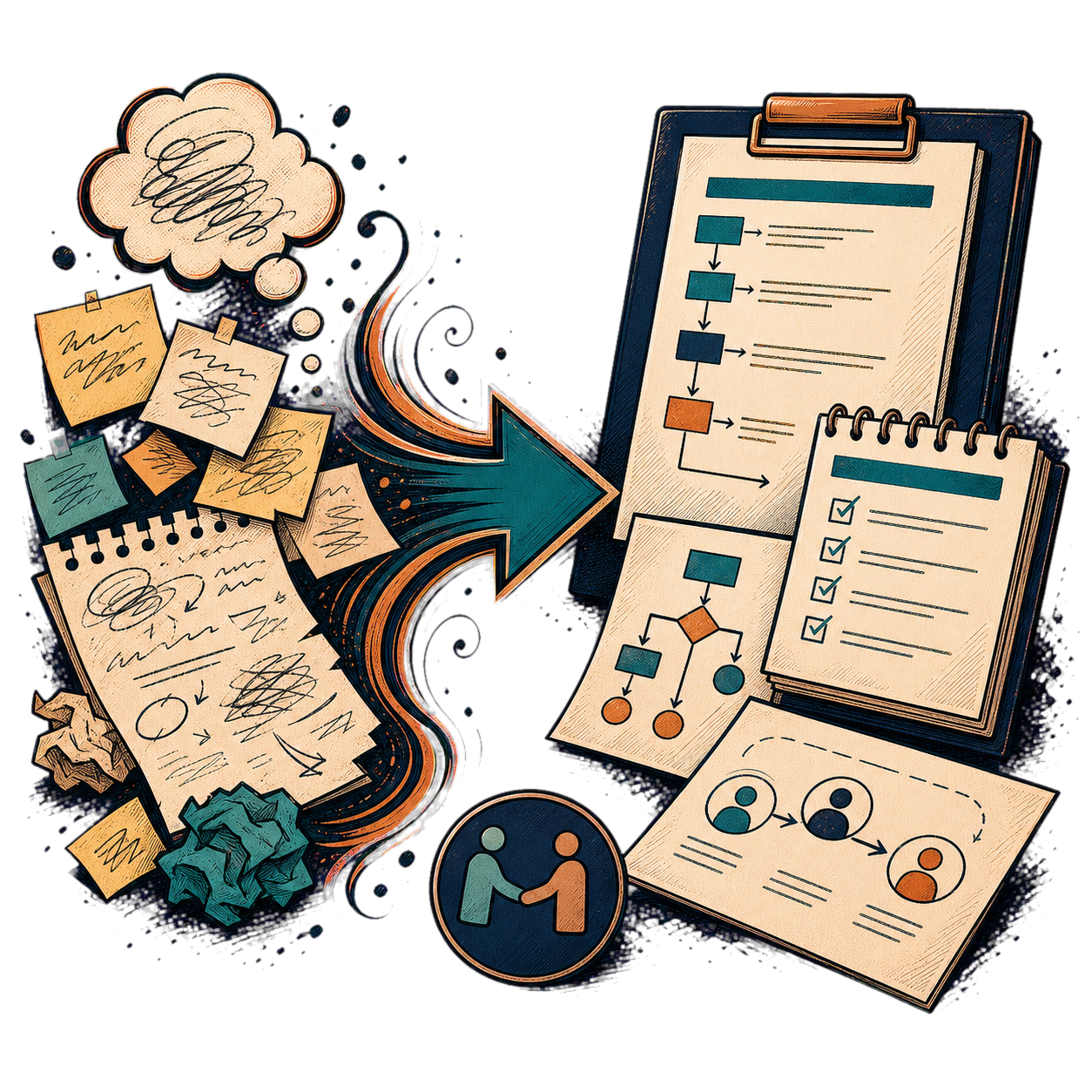
- Standard operating proceduresExplain the trigger, responsibilities, steps, decisions, exceptions, records, and definition of done.
- Ownership and role mapsClarify who owns the process, completes the work, approves decisions, and receives each handoff.
- Checklists and decision guidesGive people concise support for recurring work, quality checks, required information, and common exceptions.
- Training and handoff materialHelp people understand the process, locate the right reference, and put the guidance into day-to-day use.
How the engagement works
A practical path from working knowledge to daily use.
We capture the process with the people who know it, shape the right references, validate them against real work, and establish ownership for what happens next.
- 01
Observe the work
Follow the workflow, decisions, tools, records, ownership, exceptions, and informal knowledge that keep it moving.
- 02
Structure the knowledge
Choose the right combination of procedure, map, checklist, decision guide, role definition, and training aid.
- 03
Validate with the team
Test the material with the people who perform, receive, approve, and support the work; then correct the gaps.
- 04
Publish and hand off
Place the material where people can use it and define ownership, review points, and a workable update process.
Before we document the process
A few practical questions about usefulness and upkeep.
- Is this limited to writing SOPs?
- No. The work may include process maps, checklists, role definitions, decision guidance, training material, handoff instructions, and an approach for maintaining the content.
- Can existing documentation be improved?
- Yes. Existing material can be reviewed against the current workflow, simplified, reorganized, and updated rather than replaced without reason.
- How do you keep documentation from becoming outdated?
- The handoff should identify an owner, review points, and a practical update process so the material can change with the operation.
Workflow Review
Ready to simplify the workflow your team keeps fighting with?
Start with a Workflow Review. We'll look at the process, find the friction, and identify the simplest useful next step.