
Services
Reporting, Data and Internal Tools
When status is scattered and reporting takes more effort than acting on it, Fablehaus Werks creates practical views, trackers, and lightweight tools that make the work easier to see and manage.
Start with the decision people need to make. Build only the information and tool needed to support it.
When visibility becomes another workload
The information exists. The useful view does not.
Teams lose time when they must gather, clean, compare, and explain information before they can understand the work that needs attention.
Status has to be reconstructed
Owners, missing items, dates, exceptions, and next actions live across email, spreadsheets, CRM records, and separate team views.
Reports are assembled by hand
People repeatedly collect, clean, reconcile, and reformat information before anyone can understand what is happening.
The same field means different things
Definitions, categories, records, and ownership rules are inconsistent enough to weaken follow-up and decision-making.
Existing tools do not fit the decision
A large system stores the data, but the team still needs a focused tracker or view to manage the actual workflow.
What a useful view makes possible
The right work becomes easier to see and act on.
The goal is not more reporting. It is dependable information arranged around the decisions, exceptions, and next actions that matter.
- Clearer operational status
Owners, progress, missing information, deadlines, exceptions, and next actions are easier to review.
- More dependable information
Definitions, fields, records, and reporting rules better reflect the workflow they are meant to support.
- Less manual report preparation
Recurring views require less collection, reconciliation, and formatting before they become useful.
- A proportionate internal solution
The team receives a focused report, tracker, form, portal, or lightweight tool suited to the real problem.
How we shape the useful view
Build the smallest useful view of the work.
We begin with the questions people need answered, then shape the data, interface, and connections required to make those answers dependable.
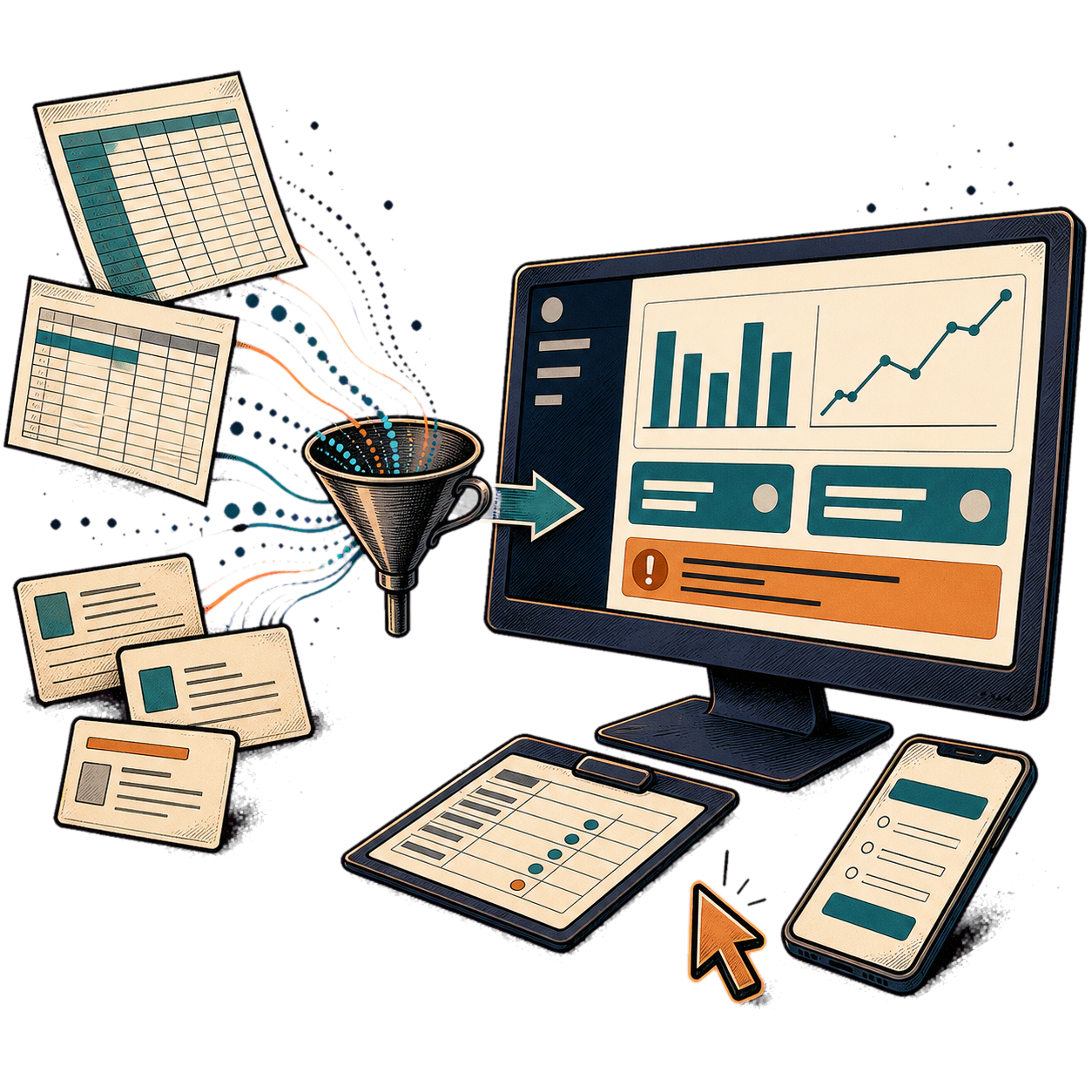
- Operational reporting and dashboardsShow meaningful status, ownership, volume, exceptions, trends, and the work that needs attention.
- Data structure and cleanupImprove definitions, fields, records, categories, ownership, and quality so the information supports the workflow.
- Trackers, forms, and portalsCreate a focused structure for intake, status, missing items, dates, approvals, and next actions.
- Connections and exportsMove or present information between practical systems where a dependable connection can remove repeated handling.
How the engagement works
A focused path from scattered data to useful action.
We define the decisions first, organize the information behind them, and test the resulting view with the people who will rely on it.
- 01
Define the decisions
Clarify who needs the information, what they need to decide or do, and how often the view must be useful.
- 02
Shape the information
Identify the sources, definitions, ownership, quality issues, and minimum data needed to answer those questions.
- 03
Build and test
Create the report, tracker, form, portal, or lightweight tool and test it against real scenarios and exceptions.
- 04
Launch and improve
Hand over the solution with clear ownership, operating guidance, and a practical way to refine it as needs change.
Before we build the view
A few practical questions about data, tools, and scope.
- Is a dashboard always the answer?
- No. A dashboard is useful only when it supports a real decision or action. A cleaner report, tracker, CRM view, or process change may solve the problem more directly.
- Can you work with our existing data and tools?
- Yes. The preferred starting point is to understand what the organization already has, improve its structure where practical, and add something new only when needed.
- Is the Workflow Control Hub a fixed software product?
- No. It describes a type of operational view that may be built for a specific workflow. The format and features depend on the organization's requirements.
Workflow Review
Ready to simplify the workflow your team keeps fighting with?
Start with a Workflow Review. We'll look at the process, find the friction, and identify the simplest useful next step.